

FARNBOROUGH TURNPIKE AND RAILWAYS
There are a great many villages and indeed small towns in Great Britain that once had a railway and now do not. But Farnborough is an example of a village that was on one of the main turnpike routes out of London but has never had a railway, despite there being many proposals
 |
This website is all about the heyday of the turnpike era, the
many failed proposals for a railway to or through Farnborough,
and the new opportunities created once the motor bus came into
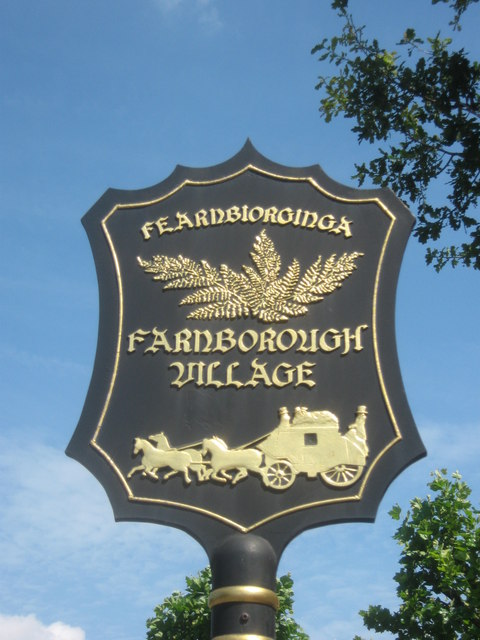
being. The turnpike heritage is remembered in the village sign (left), situated at the site of the old George and Dragon Inn in the heart of the village. Farnborough is now in the London Borough of Bromley, but was for most of its existence in the County of Kent. It is not to be confused with Farnborough in Hampshire, or indeed other places of this name elsewhere. |
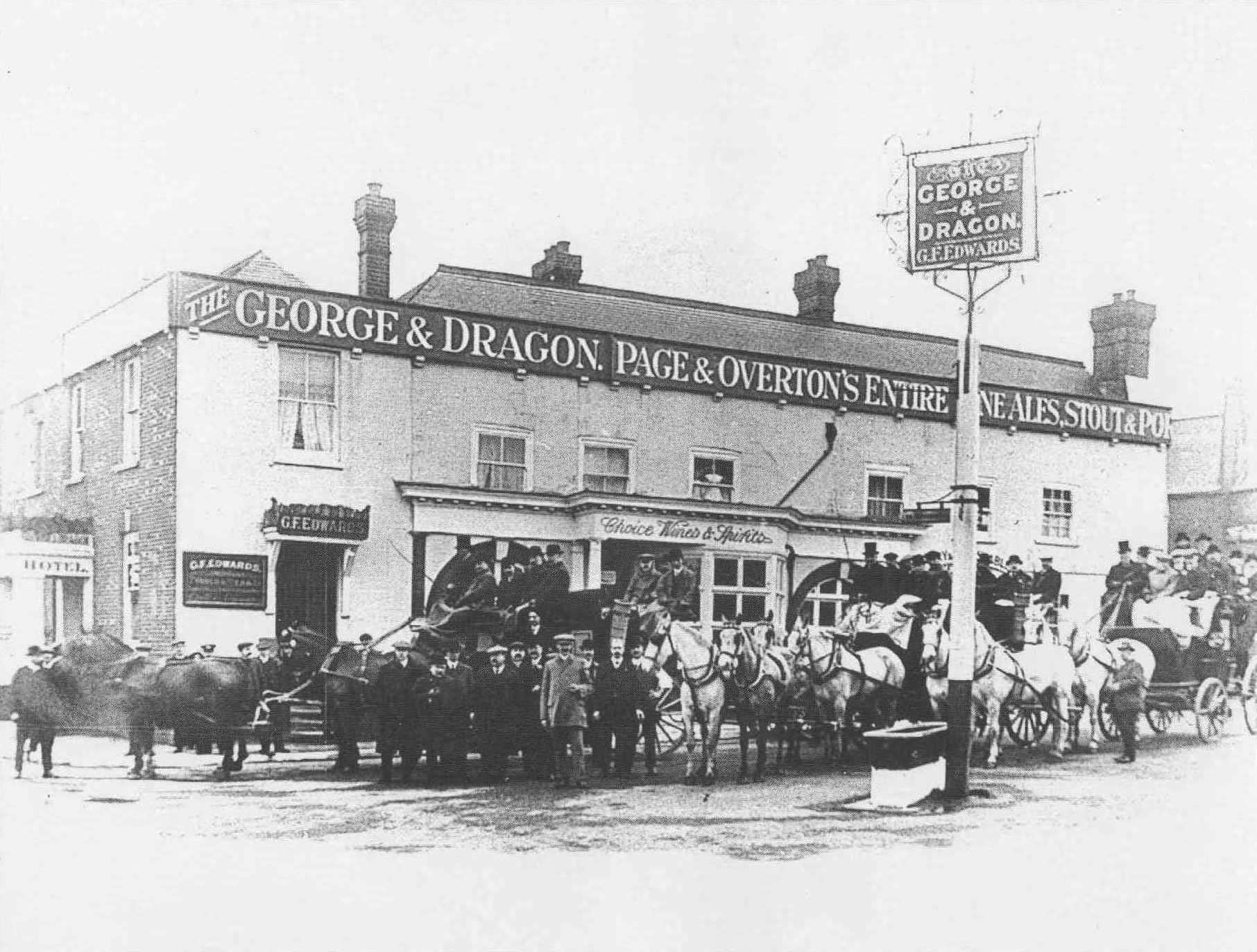
The photos at the top of all pages show:the old George and Dragon Inn that stood in the heart of the village and served travellers using the long distance road for many centuries, and the viaduct on the main line approaching London Bridge soon after opening.
Turnpike
Turnpikes have been called "one of the central pillars on which
the industrial revolution was based". The quality of roads was
vital, because many industries producing light high-value goods,
notably textiles, depended on them for relatively fast and
reliable transport which rivers and coastal vessels could not
provide. From the late 17th century, Parliament increasingly took responsibility for repairing and maintaining roads from local authorities. Turnpike Acts authorised a trust to levy tolls on those using the road and to use that income to repair and improve the road. They could also purchase property to widen or divert existing roads. The trusts were not-for-profit and maximum tolls were set. The 'turnpike' was the gate which blocked the road until the toll was paid. The first such Act, of 1663, turnpiked the Great North Road between Wadesmill in Hertfordshire and Stilton in Huntingdonshire. The next was not until 1695 (Shenfield to Harwich), but after that there were several a year, and by 1750 most of the main roads from London were turnpiked.
"Turnpike mania" followed between 1751-72, when trusts covered more than 11,500 miles of road. By the time the last was passed in 1836, there had been 942 Acts for new turnpike trusts in England and Wales. By then, turnpikes covered around 22,000 miles of road, about a fifth of the entire road network.
Despite having a comparatively small population, Farnborough had been well connected for centuries because of its position on the main road from London to Hastings. But travelling by coach had required money, and involved some risk from both highwaymen and the state of the roads.
These were only gradually relieved following the creation of the turnpike, opened through Farnborough in 1749. This was the second busiest turnpike road in southern England, exceeded only by the route from London to Dover.
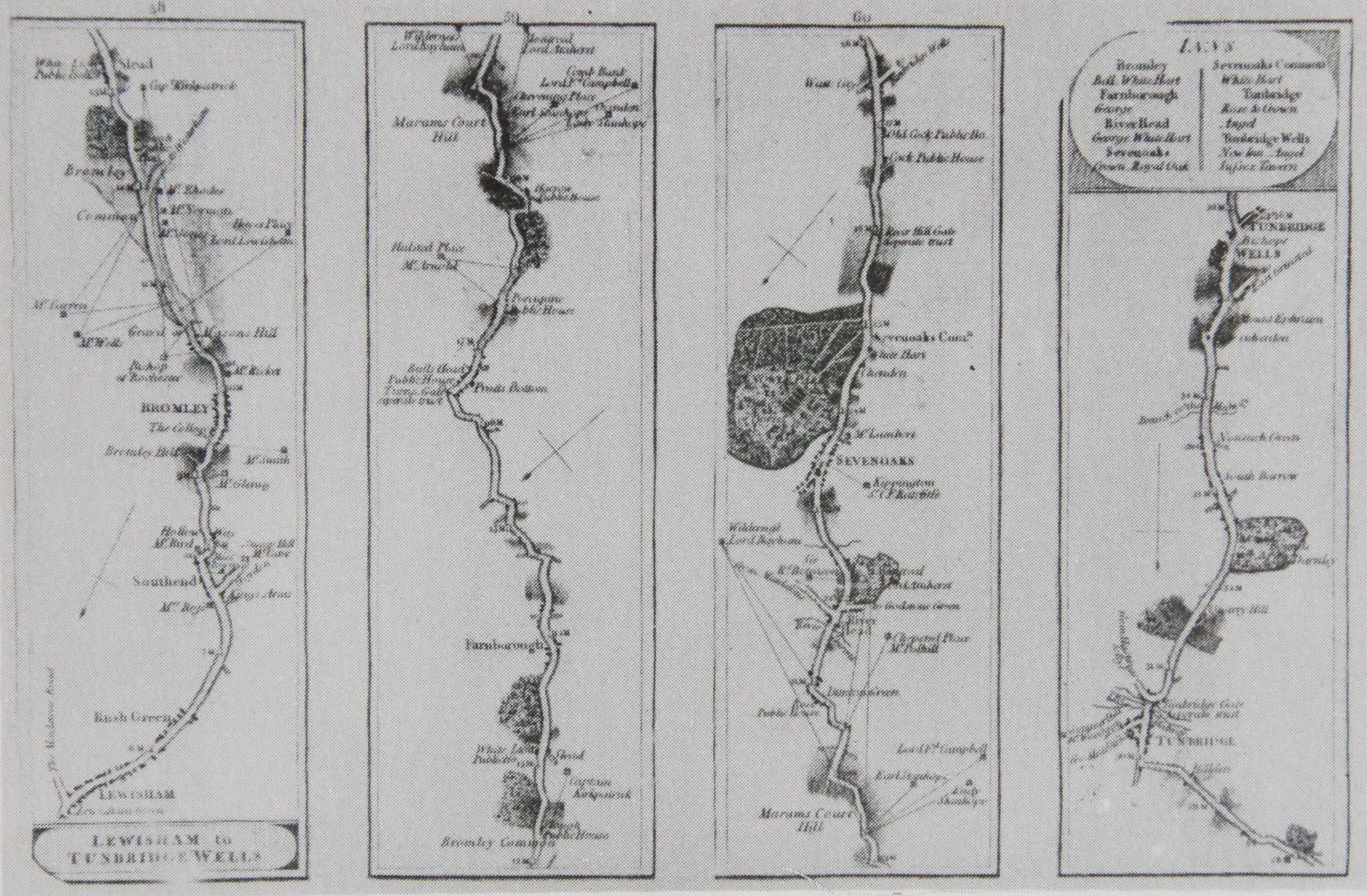
This is an engraving of the original route between Lewisham and Tenterden, although of rather poor quality reproduction. North is at the bottom, and the route is described working south from left to right across the four panels. Farnborough is in the second panel.
This website contains a comprehensive history of this turnpike road in the era that preceded the railway age, with its many changes in route made possible as the road network developed.
The coming of the railways had a major impact on all but local traffic, which mostly switched to rail. Toll roads throughout the country went into decline as it was no longer viable to collect tolls and maintain the roads. These soon fell into a poor state of repair. The New Cross Turnpike Trust's tollgates were demolished in 1865, the one at Bromley having ceased to collect tolls after 1st November 1865.
The road south of Farnborough is thought to have remained in the care of the Trust until 1872, although an Act of Parliament in 1864 authorised the abolition of tolls within a 50 mile radius of London. The toll gate at Pratts Bottom was removed in about 1865, although the former toll keeper's house on the green at the foot of Rushmore Hill (the site now occupied by the roundabout) survived until 1927. The tollgate at New Cross is immortalised, having given its name 'New Cross Gate' to the area in which it was situated.
Railways
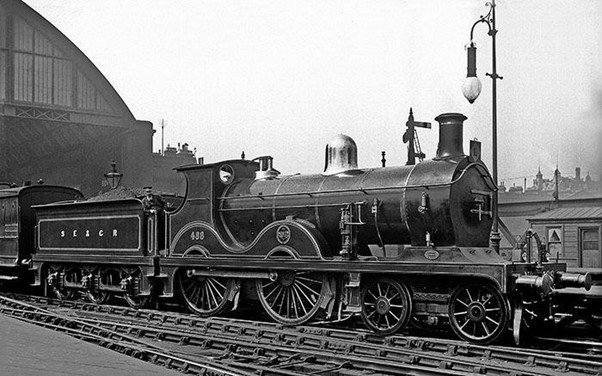
Come the railway age, and a railway connection from Farnborough to London would have been expected to follow, but this did not happen. There were some fourteen proposals, but none succeeded. Instead two main lines were eventually routed through Bromley and Orpington, at the nearest about one mile away. Had the railway come to Farnborough then the development of the village would surely have been very different.This website describes the many proposals to bring the railway through or to Farnborough., one page for each.. The maps and other details are taken from original documents archived mainly in the Kent County Archive in Maidstone. For each period, for context, there are also more general descriptions of the progress of what became today's main lines, and also some information about what was happening in Farnborough.
Railways came comparatively late to the surrounding area, despite its proximity to London. As a consequence partly of geography, partly of the lack of population and industry, and partly due to inter-company feuding, Bromley, some four miles from Farnborough did not get a railway station until 1862. Orpington, little over one mile away, did not get its line until 1865, nearly twenty-five years after the opening of the terminus at London Bridge.
 |
.jpg) |
 |
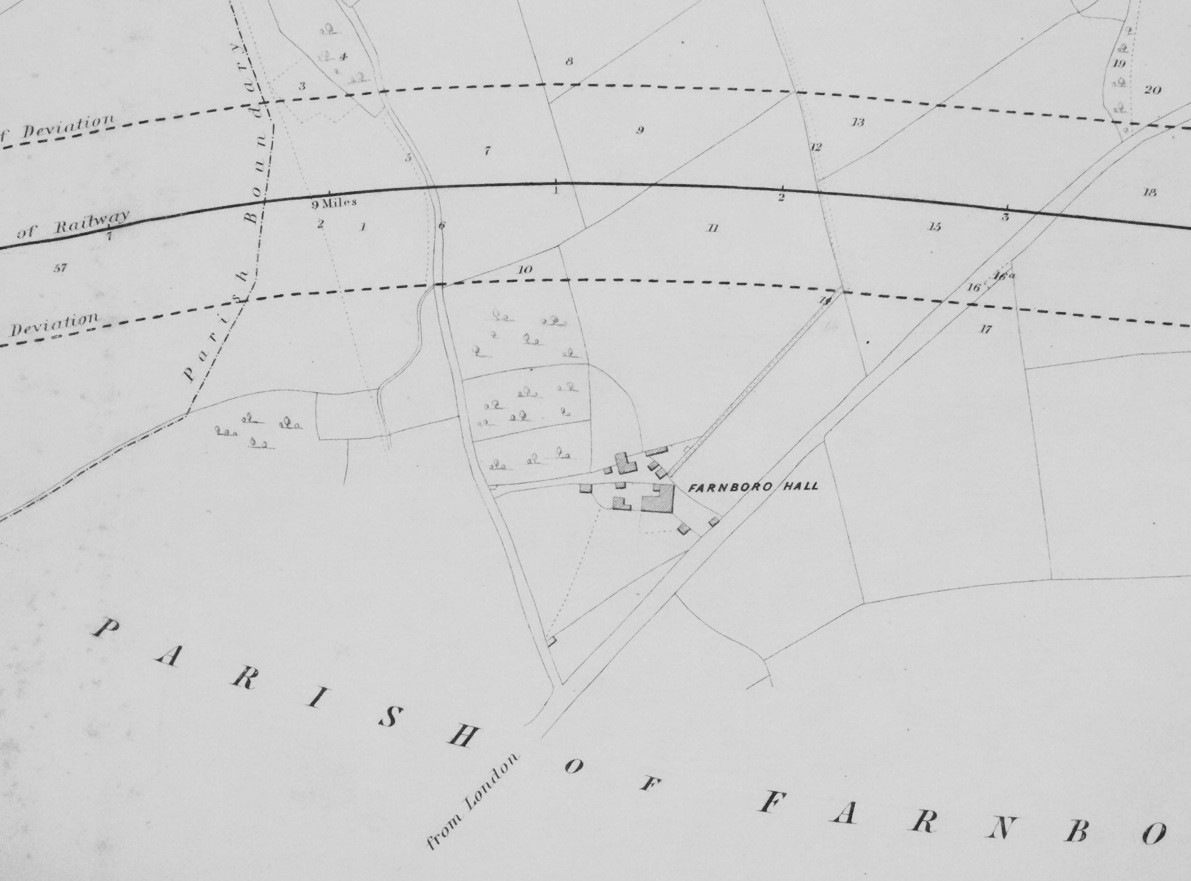 |
The first would have taken the line directly through the village centre, passing to the south of Farnborough Hall. The station would have been where the parade of shops is now. Tubbenden Lane would have required a slight diversion where it meets the High Street. In earlier proposals this would have been a through station, with the line continuing past St. Giles church toward Green Street Green and beyond. In later ones it would have been a branch line terminus. Precise alignments varied.
The second route involved taking a line across Tubbenden Lane to the north of Farnborough Hall, some 100 metres away from the High Street, as shown in the second sample diagram above. This alignment was later used for Farnborough bypass. Again the line would have continued to Green Street Green.
The various proposals are described in detail on pages accessed using the menus. Had just one of these succeeded, particularly one from the earlier decades, then Farnborough would surely have developed very differently.
It is undoubtedly true that the terrain to the south is challenging. But a further factor was the lack of sufficient population and industry to justify the effort and expenditure. Despite substantial population growth in the country as a whole, that of Bromley actually fell for a while during the early part of the Railway Age and that of Farnborough did not grow as much as would otherwise have been expected.
The first local main line, towards Maidstone, built by the London Chatham and Dover Railway, passed through Bromley and then took the easiest route southward through the Darenth Valley. The second line, built by the South Eastern Railway, could only be completed by undertaking major tunneling work at Polhill and Sevenoaks. Rather than follow the route from their own proposal of 1845 they now made their line as straight as possible, bypassing both Bromley and Farnborough.
The various proposals to bring a railway to or through Farnborough are the subject of this website They are organised by date into groups. For each of these there are one or more further pages to put the Farnborough proposals into the wider context of how railways were developing throughout the South-East London and Kent area.
FARNBOROUGH
The following pages are either new or have been revised with new material and/or photos.
About Farnborough
Farnborough is 13.4 miles from London (Charing Cross), about 10 from Sevenoaks, and 350 feet above sea level. Evidence dating from when it was a significant point on the turnpike road can still be seen today.
From ancient times the Parish of Farnborough embraced
the three settlements of Farnborough, Locksbottom and Green Street
Green, although the latter was really just a hamlet prior to
the opening of the Oak Brewery in 1830. Green Street Green was
removed from Farnborough Parish in 1937.
EXTERNAL LINKS:
Buses
Farnborough’s population remained low throughout the nineteenth century, this at a time when other towns and villages were expanding rapidly. This was of course because the railway never came.Farnborough remained a sparsely populated place, as is shown by this map dating from 1870.
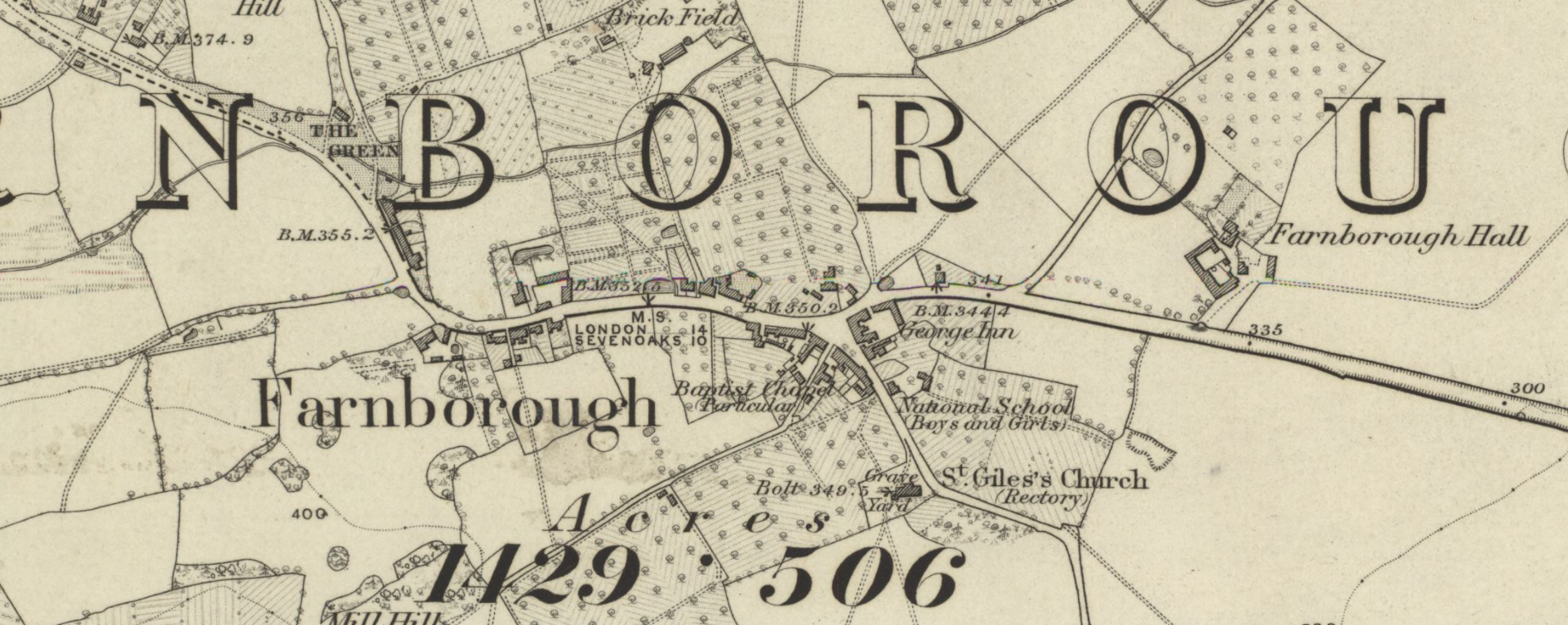
In the early years of the twentieth century the only real development was the ‘parliamentary roads’ (named after Palmerston, Pitt, Cobden and Gladstone) together with the larger houses in Tubbenden Lane. These were built when it was believed that the railway was finally coming. When it did not the builder went bankrupt, and the development was left half complete.

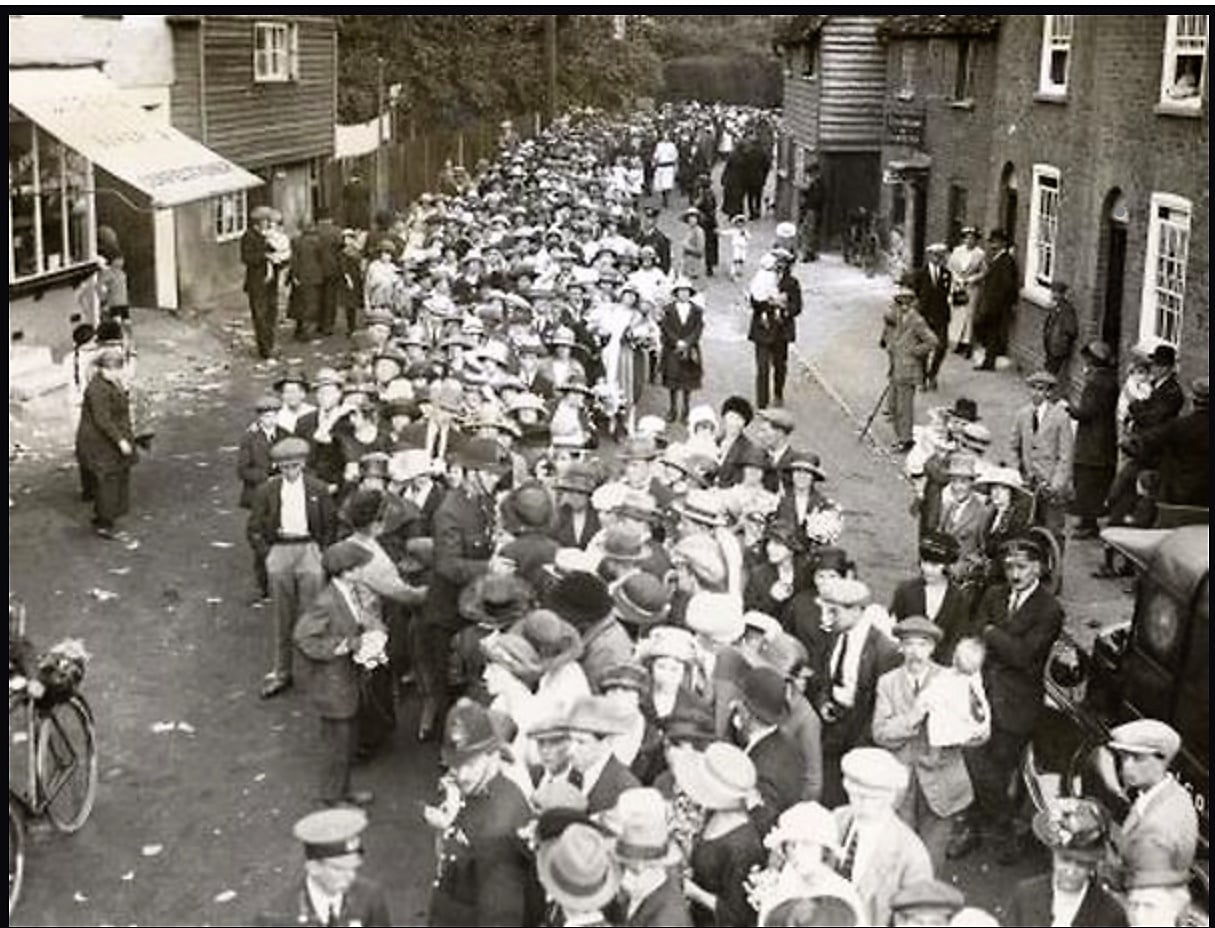
It was not until the advent of the motor bus in the early part of the twentieth century, that the relative decline of Farnborough stabilised. Many businesses in Farnborough grew to serve day trippers coming out of London to 'the Country' by bus. From that point on the accessibility and therefore popularity of the village improved, and population growth accelerated.
Thomas Tilling Ltd’s motor buses started operation on route 47 between Shoreditch and Bromley on 20 July 1912, replacing a horse bus route from ‘The City’ to Lewisham. Joint working with the London General Omnibus Company, London’s principal bus operator, began in 1908, and came to route 47, by then extended south to Farnborough in 1913.
Tea Rooms and other establishments were more than willing to satisfy the needs of day-trippers - see the photo above.
About this website
This website was launched in 2024 by transferring and developing a number of pages about railway history in the local area formerly on the Farnborough Village History website www.farnborough-kent-village.org.uk. Further pages about the turnpike were transfered from the same source in 2026.The purpose is to tell the story of the turnpike road, and also the many proposals to bring the railway to Farnborough. Had just one of the latter succeeded than Farnborough would surely be a very different place today.
The editor would welcome feedback, and submission of further material relevant to the subject area. This can be sent to:
Nick Reynolds
nickr306@gmail.com.